Friday, 5 July 2013
Sundarban Mayer Moton (Motherlike Sundarbans) campaign theme song
Music can be a powerful means to get attention, touch emotions and convey a message. Wildteam of Bangladesh uses in this video a message strengthening the relationship between the mangroves of the Sundarbans and the people living in the communities around the area. The lyrics are about the beautiful forest and the many natural treasures it gives a home to. It aims to generate awareness about the importance of nature and create a basis of support among villagers for tiger conservation. It is a good example of the IUCN CEC campaign of Love! Not Loss. The CEC campaign aims to make conservationists aware the power of a positive approach to conservation when addressing the general public.
Tuesday, 25 June 2013
Education or communication?
If you want understanding - use education. If you want action use communication or campaigning.
Campaigning involves stimulating action, best achieved by narrowing the focus and eliminating distractions and reducing options, as in advertising (Figure 1). Typically, it starts (left column) with a problem and moves a target audience through the stages of awareness (and alignment, not shown here), concern and so on, to action.
Education expands awareness of options and complexity (right-hand column). It typically takes a problem and shows that it is not so simple as you may have first thought.
More on this in Proven top tips on communicating your issues effectively from one of the UK's most successful campaigners....
Campaigning involves stimulating action, best achieved by narrowing the focus and eliminating distractions and reducing options, as in advertising (Figure 1). Typically, it starts (left column) with a problem and moves a target audience through the stages of awareness (and alignment, not shown here), concern and so on, to action.
Education expands awareness of options and complexity (right-hand column). It typically takes a problem and shows that it is not so simple as you may have first thought.
More on this in Proven top tips on communicating your issues effectively from one of the UK's most successful campaigners....
Wednesday, 5 June 2013
Learning to start a sustainable change strategy
Frogleaps offers
you knowledge and tools for sustainable development
Achieving environmental objectives requires behavior change. You want to
influence people to stop harming nature. And to start protecting our
environment. How can you maximise the results of your efforts?
Influencing behavior is difficult. Would you change your behavior just
because we ask you? Or just because we present facts to you? Probably not!
Frogleaps strengthens your change strategy with strategic marketing expertise. Look at the site...!
Sunday, 26 May 2013
Ecosystem services made visible
A picture says more than a thousand words. These pictures from a recent DEFRA publication are extremely helpful to explain ecosystem services to non-experts. They do so by making the abstract concept of ecosystem services concrete and visible by splitting them up in small parts that make much more sense to 'normal' people.
Thursday, 28 March 2013
The overview effect
OVERVIEW from Planetary Collective on Vimeo.
The awe of earth gazing. Astronauts' testimonials what this experience does with people's understanding of and attitude towards the earth and the universe.
Learning to be social
Social learning is also learning to be social. Mastering a skill, a technique or other content is a process of social learning. I experienced that through learning music and
playing together you also learn to be social. You learn to listen to each
other. To share the joy of makling it sound good. To realize the right timing
together. To build up some suspense together. You see from each other's faces when
to start a new phrase, how it develops, what to de next. You learn to
communicate without words. Developing empathy and emotional
intelligence. With the passing of the years my father and I started playing
together again. I had come to understand that making music together was often much
better than trying a social conversation. And a few years ago before his passing away,
when my father could not hear anymore the high tones and switched from violin
to viola, I made an effort to play the Mozart duos for violin and viola, and really
practiced hard to be technically able do my social duty. He loved it. Said: "you became a very handy grabbler!" From my side double social
learning!
Wednesday, 27 March 2013
Social learning
Social learning theories claim that we learn in a social context. I realize that when I remember how I learned to play the violin. I
was five, got a small violin and imitated my father as he was playing. We
played together and he demonstrated and explained how to hold my left hand and
curve my fingers, how to keep the pulse of my right hand loose, use my elbow
and keep my shoulder low. I had to practice alone, learn simple tunes by heart
and then reproduce the modeled violin behaviour with some positive or negative
reinforcement. This went on for years. Later I had other
teachers, but the fun part always was playing together. Scales and exercises
sounded much better: less out of tune and more volume. A bit like the Mouse and the Elephant
walking over the wooden bridge, says the Mouse to the Elephant: “listen what a big
noise we make!” When I had enough skills to play with others, the real fun
started. Hours of daily practice were rewarded and stimulated by playing music of
famous composers and by the social and sometimes competitive environment of my
violin duo, the student orchestras, or for a while my piano trio. Yes, the social context.
Monday, 25 March 2013
Dealing with uncertainty
We always come to the point that we have to make a choice. Hercules at the cross roads avoided the choice between just turning right or left. He expanded the set of choices and widened them. He reflected and checked his assumptions while analyzing his options. When making a choice: go for the one with the long term impact and
benefits (Virtue), don’t get distracted with short term emotions (Pleasure). Then stick with your
choice and prepare for having made the wrong choice. That is dealing with
uncertainty. Read more in DECISIVE, the latest book of Chip and Dan Heath, study the painting by Sebastiano Ricci or learn from the life of Hercules.
Saturday, 23 March 2013
What is strategy?
Strategy is not a plan to implement. Strategy is a three-fold skill set one learns along the road
towards desired results. These skills one learns by practicing, contemplating and practicing, the way one masters an art.
The first skill is to unconditionally accept uncertainty on the
road towards a desired result.
The second skill is to see the unique possibility that will
help us gain a decisive advantage along the road towards the desired result.
The third skill is to timely exploit that unique possibility
to gain this decisive advantage on the road towards the desired result.
See also the principles of the way of the strategy.
Thursday, 21 March 2013
Learning from the mental transformation process
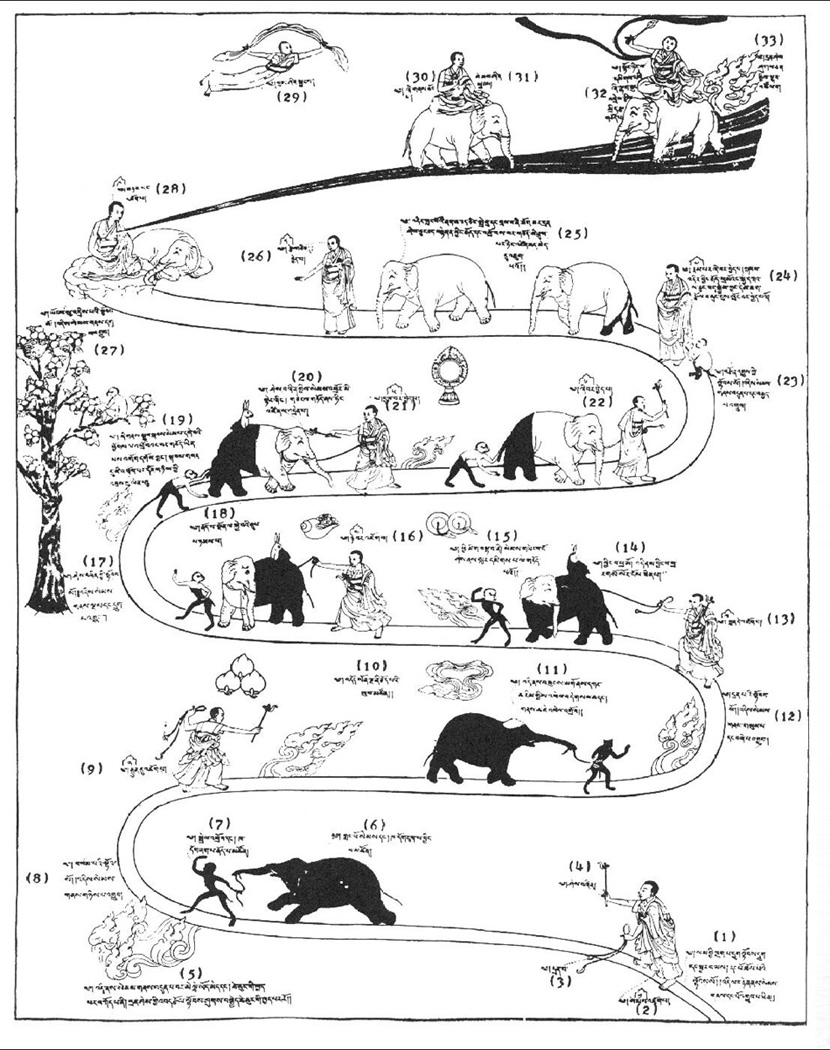
Training to transform the mind is in Asian Bhuddism often depicted as a man trying to catch an ox or a monk walking with an elephant. In a posting some years ago I tried to summarize my learning for behaviour change from the Zen story of taming the ox:
1. analyzing the situation
2. identifying the behaviour we want to change
3. defining desired behaviour
4. analyzing obstacles for change
5. analyzing motives for change
6. making change easy
7. making the new behaviour normal and desirable
8. change has turned into a habit
9. we understand everything changes and all phenomena are interdependent
10. we apply the learning about change in other spheres of life.
1. analyzing the situation
2. identifying the behaviour we want to change
3. defining desired behaviour
4. analyzing obstacles for change
5. analyzing motives for change
6. making change easy
7. making the new behaviour normal and desirable
8. change has turned into a habit
9. we understand everything changes and all phenomena are interdependent
10. we apply the learning about change in other spheres of life.
Most important is to realize that the end is not static, but the beginning of a new cycle to create more impact.
Subscribe to:
Posts (Atom)

.jpg)


